What actually makes an AI agent "agentic"
Agentic AI is the same LLM wired into a loop: plan, act, observe, repeat, until a goal is met instead of answered in one reply.
2 min read
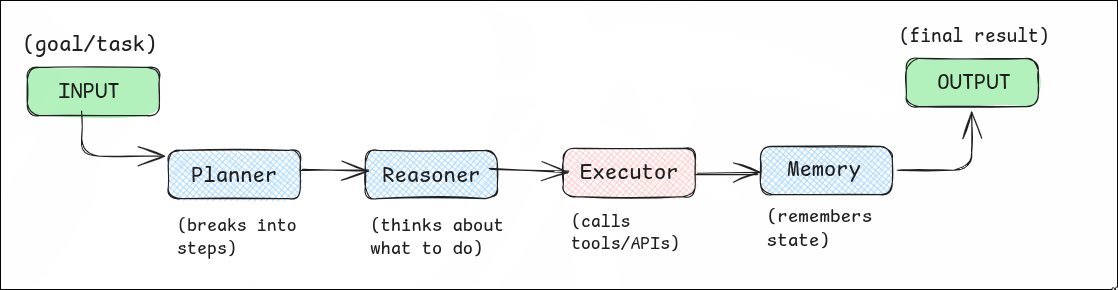
A plain LLM answers one prompt with one reply. An agent wraps that same LLM in a loop: it plans a goal into steps, calls tools to act on the world, reads back what happened, and decides what to do next, repeating until the goal is met.
Say “book me a trip to Delhi this weekend under 5000 rupees.” A chat model can describe how you’d do that. An agent searches flights, checks hotels, compares costs, books through an API, and emails you the result. Same model in both cases. What changed is the loop around it.
What the loop needs#
- A goal, broken into smaller steps instead of one big instruction.
- Tools, APIs or scripts the agent can call to actually do something.
- Memory, so it can refer back to earlier steps or past runs instead of starting blind each time.
- Judgment, to pick the next action from whatever the last one returned, and to know when the goal is actually done.
This pattern is usually called ReAct: reason about what to do, act, observe the result, repeat.
Where it’s actually useful#
A coding agent that reads a bug report, edits the code, runs the tests, and commits if they pass. A support agent that looks up an order, decides a refund is warranted, and issues it through an API rather than drafting a reply for a human to send. The common thread: the task needs more than one step, and the right next step depends on what the previous one returned.
Where it’s overkill: anything that’s really just one API call with extra steps. If the task doesn’t need branching on intermediate results, a plain workflow is simpler and easier to debug than an agent.
The one-line version#
An LLM is the reasoning step. An agent is that same reasoning step wired into a loop with tools, memory, and a way to tell when it’s done.
For the deeper version of this, Anthropic’s piece on building effective agents is worth reading before you build one.